The number on the slide is a lie
Your paid social dashboard says you’re paying €0.45 per click. Your CMO is happy. Your CFO is nodding. But nobody has counted all the things that had to happen for that click to reach your landing page and become a data point in your attribution model.
This post is about the full unit cost of a single marketing click — and why “cheap” clicks are often the most expensive ones once you factor in everything downstream.
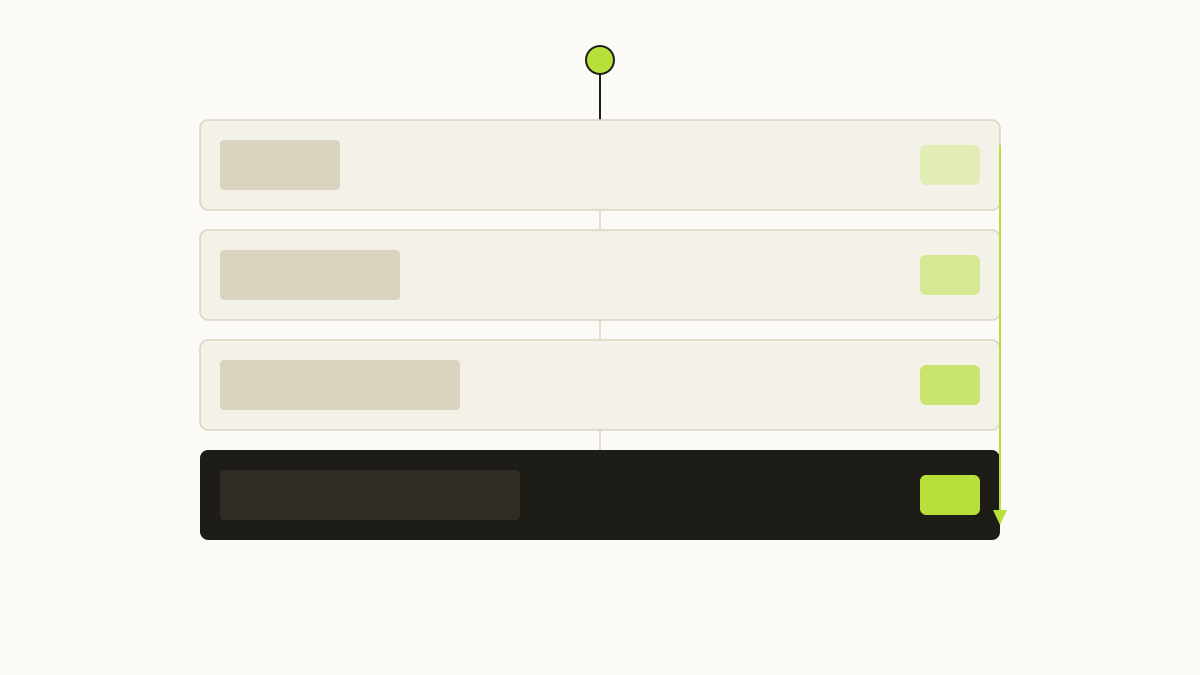
Tier 1: The media cost
This is what everyone measures. The amount you paid the platform — Google, Meta, LinkedIn, a newsletter publisher — for the traffic. It’s the CPC your dashboard reports.
For paid channels this is obvious. For organic or owned channels (SEO, email, social) the “cost” is more diffuse: writer time, editor time, design time, scheduling time, and the amortized tooling costs for whatever you used to produce and distribute the content.
Organic clicks aren’t free. They’re pre-paid and easy to forget.
A realistic all-in cost for an organic blog click, once you account for content production time, SEO tooling, and CMS overhead, is often €2–6 — far higher than the paid CPC sitting in your dashboard.
Tier 2: Infrastructure and delivery costs
Every click travels through infrastructure before it lands. That infrastructure isn’t free.
Redirect hops
If your link goes through a URL shortener, a UTM injector, a link tracker, or a redirect chain, each hop takes server time. At meaningful scale — say, 100k clicks/month — even a 5ms redirect adds up. But more importantly: each hop is a failure point.
CDN and server load
The landing page the click hits has to be served. If you’re running paid campaigns at scale, you may be paying meaningfully for CDN egress, server compute, and database reads on pages that are almost entirely static. These costs get buried in your infrastructure invoice, not your media invoice.
Link management overhead
Somebody created that link. Somebody named the campaign, typed the UTM parameters, tested the redirect, and shared it. If your team spends even 4 minutes per link and you’re creating 200 links a month, that’s 13+ hours of human time every month — not accounted for anywhere in your CPC calculation.
Tier 3: Attribution and analytics costs
This is the tier that surprises most marketing teams.
Analytics tooling
GA4, Mixpanel, Amplitude, Heap — you’re paying a per-event or per-user rate (or a flat seat fee) to store and query click data. If you’re sending click events enriched with UTM parameters, every click generates 1–3 events in your analytics stack. At 500k clicks/month, that’s real money.
Attribution modeling
If you’re using a multi-touch attribution tool — Northbeam, Triple Whale, Rockerbox — you’re paying a percentage of media spend or a flat fee to understand where those clicks came from. That fee is a per-click cost in disguise. A team spending €50k/month on media and €2k/month on attribution is paying €0.04/click just for the privilege of knowing which channel worked.
Data team time
Someone has to clean the data, reconcile the dashboards, and answer “why don’t these numbers match?” every week. In a 5-person marketing team, that might be 2 hours/week. In a 15-person team, it can balloon to a half-time job.
Tier 4: The cost of uncertainty
Dark traffic, UTM breakage, blocked referrers, and iOS/Android attribution limits mean a meaningful fraction of your clicks are unattributed even when they convert. That fraction is almost always higher than people think — typically 20–40% of actual conversions.
When you optimize your channel mix based on attributed CPC and you’re missing 30% of your conversions, you’re making expensive decisions on incomplete data. The cost of that uncertainty compounds over months and quarters.
The channel that looks cheapest on your dashboard might be the most expensive once you account for attribution loss.
What to do with this
You don’t need to build a unit economics model that captures every dollar. But three changes will give you a clearer picture:
- Add a “total channel cost” column to your channel comparison — including tooling, team time, and infrastructure, not just media spend.
- Track unattributed conversion rate by channel. If one channel consistently has higher dark traffic rates, its true CPC is higher than the dashboard shows.
- Eliminate redirect chains. Every unnecessary hop adds latency, failure risk, and attribution noise. Use a single, clean UTM-tagged short link as the canonical entry point.
The goal isn’t to make every click look expensive. It’s to stop making channel decisions on a number that’s missing 60% of the inputs.