Links aren’t disposable
Here’s how most teams think about a link: someone needs to share a URL for a campaign, they create a short link, they use it, the campaign ends, and the link is forgotten.
That mental model is costing you. A well-constructed, properly tagged link is not a disposable campaign asset. It’s a durable data asset. And like any asset, it accumulates value over time — or it decays, depending on how you treat it.
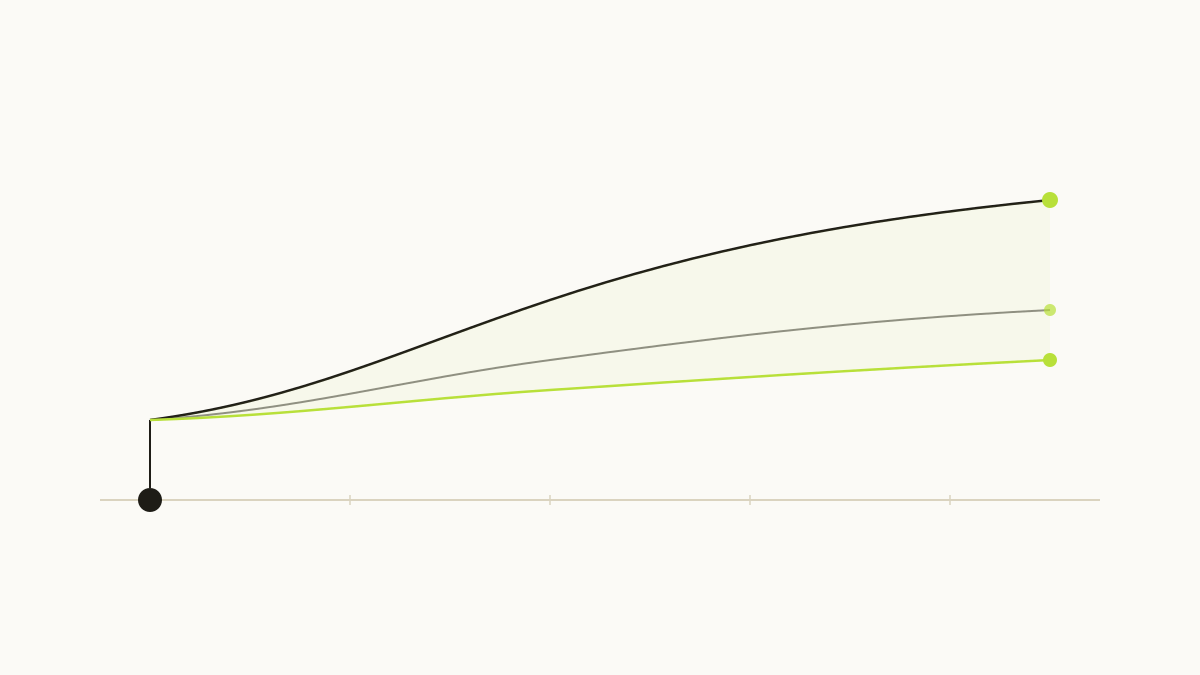
What value a link accumulates
1. Analytics signal over time
A link created with clean, consistent UTM parameters contributes to your attribution model every time it’s clicked — not just during the campaign it was originally created for.
That newsletter link from 8 months ago? Still driving 200 clicks/month. Every one of those clicks is correctly attributed to email / newsletter / product-update-q3. Your analytics can tell you:
- How long-form newsletter content performs compared to short-form (utm_content)
- Which product update topics drive the most long-tail engagement (utm_term)
- How newsletter-sourced users compare in retention and LTV to paid-sourced users
None of this is possible if the link was created with a raw URL and no UTMs, or with inconsistent tagging.
Clean UTMs on old links are retrospective analytics capital. You didn’t know you’d want that breakdown when you created the link. But because you tagged it correctly, you have it now.
2. Retargeting audience membership
Every click on a properly tagged link is a potential retargeting signal. If your link lands on a page with a retargeting pixel, the click builds your audience. If the landing page is tagged with utm_source=linkedin, you can create a retargeting audience of people who first discovered you via LinkedIn.
This segment has real monetary value. A retargeting audience of 10,000 LinkedIn-sourced visitors who haven’t converted yet is worth — conservatively — several thousand euros in expected future revenue, assuming even a 2–3% eventual conversion rate.
That audience was built, click by click, by links that existed for months. A link that expired after one campaign ended didn’t contribute to it.
3. Institutional knowledge and velocity
When a link is tagged with a consistent vocabulary — not facebook sometimes and Facebook other times — it contributes to a body of institutional knowledge that any team member can query.
“Which email subject lines have historically driven the most product page visits?” If your links have been tagged consistently for two years, that question is answerable in minutes. If they haven’t, it’s unanswerable.
The value of answerable questions compounds with team size and tenure. A 10-person marketing team where everyone uses the same link vocabulary can move faster than a 30-person team where nobody trusts the data.
4. Cross-campaign pattern recognition
Links don’t just tell you how individual campaigns performed. Over time, they reveal patterns:
- Which content formats (webinars, blog posts, case studies) drive the highest-LTV traffic
- Which sources produce trial users who upgrade vs. trial users who churn
- Whether traffic from brand mentions in press coverage behaves differently than traffic from your own social posts
These patterns are invisible at the campaign level. They emerge only when you have months of cleanly tagged link data that can be queried across campaigns.
Modeling the compounding value
Let’s put a rough number on this.
Assume a single well-tagged link drives: - 500 clicks in the first month (active campaign) - 100 clicks/month for the next 12 months (residual traffic)
That’s 1,700 total clicks over 13 months.
If each click has an attribution value of €0.80 (the value of a correctly attributed session vs. an unattributed one), the attribution value of proper tagging is €1,360 over the link’s life.
Add retargeting value: if 30% of those clicks are new users added to a retargeting audience worth €50 CPM, that’s 510 audience members × €0.05 = €25.50 in retargeting inventory.
The math only works if the tagging is consistent. One link with inconsistent UTMs doesn’t produce corrupted data in isolation. But 20% of links with inconsistent UTMs corrupts the whole dataset.
The depreciation risk
Every link also has a depreciation curve:
- Broken destination → immediate write-down to zero click value
- Inconsistent tagging → gradual erosion of analytics signal quality
- Expired campaign context → historical data still valid, but no new value accruing
- Platform change (iOS, browser privacy) → external depreciation of attribution window
The teams that treat links as assets actively manage this depreciation. They audit link health, maintain redirect rules for expired destinations, and periodically review whether old UTM vocabulary still maps correctly.
A practical framework for link longevity
- Create every link with full UTM context, even for “one-off” shares. You don’t know in advance which links will have long tails.
- Use a controlled vocabulary for sources, mediums, and content types. Enforce it with tooling, not willpower.
- Never delete short links — redirect old destinations to the closest live equivalent.
- Document campaign context at link creation — a short note about what the link was for, who the audience was, and what the goal was.
- Treat your link library as a queryable dataset, not a list of redirects.
The compounding returns are real
A marketing team that has maintained a clean, consistent link library for two years has a durable analytical advantage over one that hasn’t. Their attribution models are more accurate. Their retargeting audiences are richer. Their channel comparisons are based on real signal, not noise.
Every well-tagged link is a small, compounding investment in that advantage. Every poorly tagged link — or forgotten one — is a withdrawal.