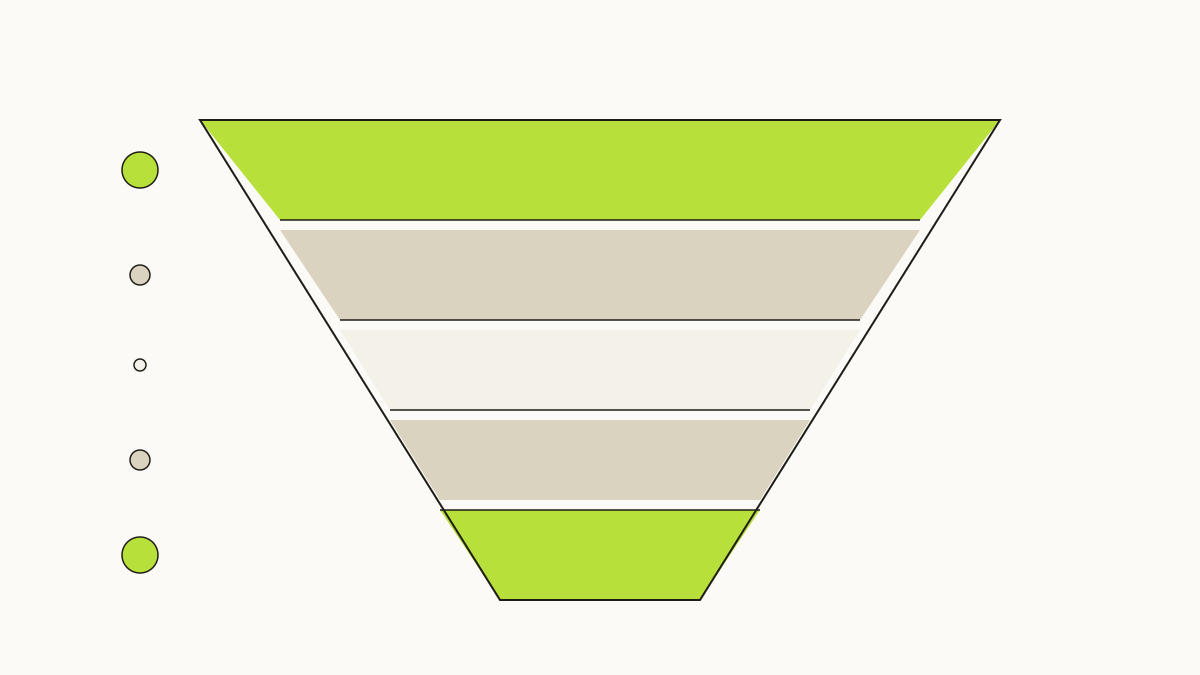
Attribution models get treated like a settings dropdown — pick one, move on. In practice, the model you choose shapes which channels get budget, which campaigns get killed, and which team members get credit. Getting it wrong doesn’t produce a wrong number. It produces a plausible but misleading number, which is worse.
Here’s how to think through the choice.
What an attribution model actually does
Every conversion has a path: a sequence of touchpoints the user encountered before they bought, signed up, or requested a demo. An attribution model is a rule for distributing credit across that path.
The model answers: of all the marketing that touched this customer, how much of this conversion do we assign to each piece?
The answer drives your reported ROI per channel. Change the model, change the ROI, change the budget decision.
First-touch attribution
First-touch gives 100% of the credit to the first interaction a user had with your brand.
What it measures well: acquisition efficiency. Which channels are creating awareness and pulling net-new people into your funnel?
Where it breaks: it ignores everything that happened after awareness. A user might find you via an organic blog post, forget about you for two months, see a retargeting ad, click a referral link from a colleague, and then sign up. First-touch credits the blog post and calls the retargeting campaign worthless.
When first-touch is the right call
First-touch works best when:
- Your sales cycle is short (hours to a few days)
- Your top-of-funnel spend is the main variable you’re optimizing
- You’re an early-stage company trying to understand which acquisition channels to double down on
- Your product is inherently impulse-friendly — the first exposure often is the only exposure before conversion
For a B2C e-commerce product with a $25 average order value, first-touch often tells you everything you need.
Last-touch attribution
Last-touch gives 100% of the credit to the final interaction before conversion.
What it measures well: conversion efficiency. Which channels are closing customers who were already in your orbit?
Where it breaks: it systematically undervalues awareness. If every customer’s last touch before signing up is a branded Google search (because they remembered your name and Googled it), your model will credit Google Brand and suggest you should cut everything else. But nothing about that conclusion is actionable — branded search is a symptom of successful awareness, not its cause.
When last-touch is the right call
Last-touch works best when:
- You need simplicity above all and the team isn’t sophisticated enough to act on nuance yet
- Your sales cycle is effectively zero — think flash sales, in-app upsells
- You’re doing conversion rate optimization on the bottom of the funnel and want to isolate the final step
- Your attribution window is very short and the gap between first and last touch is usually a single session
Linear and time-decay models
Linear attribution distributes credit equally across all touchpoints. Time-decay gives more credit to touchpoints that occurred closer to the conversion.
Both are compromises — attempts to acknowledge the full path without making a strong claim about which touchpoint mattered most.
Linear works well when you genuinely believe every touchpoint contributed equally and your goal is to avoid starving any channel. It’s the safe default for teams that don’t have enough conversion volume to run meaningful model comparisons.
Time-decay works well for long B2B sales cycles where recent engagement is a meaningful signal of purchase intent. If a prospect went dark for eight months and then started clicking your retargeting ads again, that recent activity probably matters more than what they clicked in January.
Position-based (U-shaped) attribution
Position-based splits credit: typically 40% to first touch, 40% to last touch, and the remaining 20% spread across the middle.
This is the right model for teams that care about both acquisition and conversion — which is most growth teams. It acknowledges that opening the relationship and closing it are the two most strategically important moments, while not completely ignoring nurture.
The practical catch
Position-based models require clean, complete path data. If your UTM parameters break mid-funnel, the middle touchpoints go missing and you’re back to an accidental first/last model with phantom gaps.
The model your business actually needs
Rather than asking “which model is best,” ask three questions:
1. What decision will this model drive? If you’re deciding where to spend next quarter’s acquisition budget, you need first-touch or position-based. If you’re optimizing a conversion funnel, you need last-touch or time-decay.
2. How long is your typical sales cycle? Shorter cycles → simpler models are fine. Longer cycles → you need to respect the full path.
3. Do you have enough data to trust the model? Multi-touch models require a lot of complete conversion paths to produce stable signals. If you have fewer than 100 conversions per month, even a sophisticated model will produce noisy results. Start with first-touch or last-touch and add complexity only when the data can support it.
A note on data-driven attribution
GA4’s data-driven model uses machine learning to assign fractional credit based on how paths that included each touchpoint compared to paths that didn’t. In theory, it’s the most accurate approach. In practice:
- It requires significant conversion volume (thousands per month)
- It’s a black box — you can’t explain why a channel received 23% credit
- It optimizes for the patterns in your historical data, which means it bakes in your existing biases
Use data-driven attribution if you have the volume and you’re comfortable with the opacity. Use a simpler model if you need to explain and defend budget decisions to stakeholders who will ask why.
The real answer
The best teams don’t pick one model and live in it. They maintain two views: a first-touch view to evaluate acquisition strategy, and a last-touch or position-based view to evaluate conversion strategy. When the two views agree on a channel’s value, you can be confident. When they diverge, you’ve found something worth investigating.